Florida Memory is administered by the Florida Department of State, Division of Library and Information Services, Bureau of Archives and Records Management. The digitized records on Florida Memory come from the collections of the State Archives of Florida and the special collections of the State Library of Florida.

State Archives of Florida
- ArchivesFlorida.com
- State Archives Online Catalog
- ArchivesFlorida.com
- ArchivesFlorida.com
State Library of Florida
Related Sites
 Listen: The Latin Program
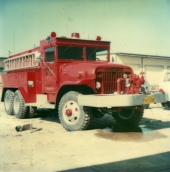
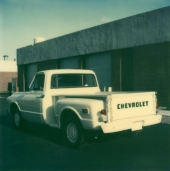
Instant Photography
- The Polaroid Model 95 was the first instant camera released to the public.
- Once the film was ejected from the camera, the photograph developed in less than one minute.
- Polaroid released its first instant color film in 1963.
History
As easy as film photography had become by the 1940s, it still required patience. A photographer needed the skills and equipment to develop photos themselves, or they had to mail film off to a lab and wait for the prints to return. In either case, a person had to make an investment of time to see the fruits of their labor. That changed in 1948 when Edwin A. Land and the Polaroid company debuted the instant photograph. Land first conceived of the instant photograph on vacation in New Mexico, when his daughter expressed impatience that she could not see the pictures he had just taken.
Land and his colleagues at Polaroid found a way to condense an entire darkroom into a portable camera, including chemical baths to start and stop development and equipment to wash and dry the paper. In addition to clearing these technical hurdles, Land wanted the instant photograph to develop in less than one minute after it ejected from the camera. After exposure, the film automatically ejected from the camera, and mechanical rollers spread the necessary chemicals over the images. Even in the earliest black and white iterations of instant film, a photographer only needed to wait one minute to see the finished product. Instant photography was very popular among amateurs but was also used by professionals to capture test images or behind-the-scenes photos. Although early Polaroid images were somewhat lower quality than traditional photographic processes, 60 seconds was hard to beat, and consumers responded well to the promise of an instant photograph. Over the next 15 years, chemical breakthroughs resulted in new and improved Polaroid cameras and films, and instant color film was available by 1963.
Did You Know?
Don’t shake a Polaroid picture; it won’t develop any faster, and you run the risk of creating a bubble in one of the layers of chemicals contained in the sheet. It's best just to let it sit.
"Gill-man" Ricou Browning posing for a kiss with an unidentified woman on the set of "Revenge of the Creature" at Marine Studios, 1954. (State Archives of Florida)